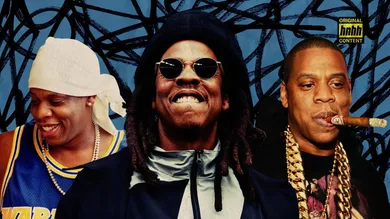


Evolving in Hip Hop isn’t impossible. What’s difficult is entering new eras when your audience clings to nostalgia. Fans fall in love with a version of you that made them feel something once and they rarely want you to change. That’s why so many artists get stuck chasing old formulas, trying to replicate past hits, or building tours around the same setlist from 20 years ago. But not Jay-Z.
Shawn Carter moved differently. Across three decades, he shifted not just how he rapped, but what his career stood for. The early verses were coded survival manuals as Marcy logic was dressed in designer cloth. As time moved, so did the narrative. Luxury replaced scarcity. Beyoncé replaced anonymity. Boardrooms replaced corners. The music kept its pulse.
Read More: Jay-Z Defends Bad Bunny Amid MAGA Super Bowl Backlash
Every shift was deliberate. He switched up flows and changed rooms. Roc-A-Fella became Roc Nation. Champagne boycotts turned into full ownership. NFL partnerships replaced radio placements. Even in silence, the moves were loud. Jay-Z didn’t just evolve, he adjusted the culture to meet him where he was. Each era was a strategic change in position. That’s architecture.
Jay-Z's Hustler’s Blueprint Era (1996–1999)
Rap didn’t need another rags-to-riches story in 1996. What it needed was someone who could narrate the climb without pretending they’d already escaped. Jay-Z brought that. He entered the industry fully formed as lyrically mature and business-minded from the start. Reasonable Doubt was a debut that read as his manifesto.
This era framed Jay-Z as a calculated risk-taker. He rapped about street economics like an insider who knew the costs. Yet, there was never desperation in his voice, just strategy. While other emcees focused on volume or image, Jay focused on infrastructure. He helped build Roc-A-Fella from the ground up and studied the distribution game. He played the part of artist and executive without waiting for permission.
Read More: Top 8 Artists Who Could Battle Jay-Z In A Verzuz
Then, Vol. 2… Hard Knock Life turned him into a commercial heavyweight. Even at the height of radio success, he kept the language coded so the streets could translate what the charts couldn’t. This era was about access. Jay-Z didn’t kick down the door. He sold you the blueprint for how he picked the lock.
The Throne Builder (2000–2003)
When we reach the 2000s era, Jay-Z was reshaping the very idea of what it looked like. The Dynasty: Roc La Familia blurred the line between solo project and crew showcase, reinforcing that Jay was building an empire. By the time The Blueprint landed, the tone shifted completely.
The timing of The Blueprint made it a cultural time capsule. Released on September 11, 2001, it dropped on a day that would reshape the world. Yet, the album still cut through. Soul samples from Kanye West and Just Blaze reintroduced warmth and elegance to Rap production. Jay’s delivery was clear; he was done proving he could rap. Now, he was proving that no one else could reach where he stood.
Read More: Top 25 Best Jay-Z Songs Of All Time
Still, every ascension has its test. For Jay, it came in the form of Nas. Jay emerged with scars, but also with visibility that no East Coast rapper had claimed since Biggie’s death. He wasn’t simply trying to be the next King of New York. He was establishing himself as the last one.
The Blueprint 2 was a sprawling, sometimes unfocused double album that still reinforced his reach. And with The Black Album, Jay staged his own exit. There was no label drama or loss in relevance. Just a self-authored goodbye backed by producers like Pharrell, Timbaland, and Rick Rubin. It felt like a coronation.
The Executive Stretch (2004–2006)
Disappearing from the mic didn’t mean stepping out of power. When Jay-Z announced his retirement after The Black Album, the industry waited. Within a year, he reappeared in a different form as the president of Def Jam.
This wasn’t a symbolic appointment but a calculated repositioning. Jay was now making boardroom decisions that crafted the next wave of artists. He signed Rihanna and backed Ne-Yo. He greenlit albums and negotiated deals. His influence was no longer limited to his own sound. This era of Jay-Z was in the building of structures, release schedules, and budgets. He was a rapper who had become the system.
Read More: Jay Z Launches "Comador" Cigar Line
As Jay stepped into executive power, not every artist under the label felt protected or seen. No solo album came from this time, but the moves made here widened the scope of what Hip Hop power could look like. Jay-Z was still in the studio but from the other side of the desk. He was learning how deals worked and how markets moved. More importanly, how to translate his instincts into institutional control.
The American Mogul (2006–2013)
Returning to Rap after a public retirement could’ve felt like a stumble. Jay-Z made it look easy. Kingdom Come wasn’t universally praised, but it didn’t have to be. It was transitional, a reintroduction. What followed was an era of deliberate moves that increased global reach.
American Gangster served as a reset. Inspired by the Denzel Washington film, the album was lush and rooted in nostalgia without sounding stuck. Jay-Z merged past experience with present perspective in this era, rapping from the margins of morality with maturity. It was one of his most cohesive bodies of work that was less about hits and more about control.
Read More: Don't Call It A Comeback: 12 Triumphant Returns To Rap
Then came The Blueprint 3, which marked a pivot toward mass appeal. “Empire State of Mind” with Alicia Keys became an anthem. Tracks like “Run This Town” and “On to the Next One” expanded his sound that wasn't chasing youth but commanding attention.
However, the most visible symbol of his mogul status arrived with Watch the Throne. The collaboration with Kanye West was more than two artists making music, as two Black men showcased excess and access. The tour was massive and the imagery intentional. “Otis” and “No Church in the Wild” merged luxury with critique.
Read More: A Timeline Of The Throne: How Kanye West & Jay Z's Album Came To Be
During this stretch, Jay also launched ventures outside of music. Roc Nation became a full-service entertainment company. Then, Roc Nation Sports emerged. Luxury became the narrative, and branding became a bar.
Brand Over Bars (2013–2016)
Jay-Z has never been afraid to test the system, but this era was about building his own. With Magna Carta Holy Grail, the strategy was louder than the sound. A million Samsung users got the album before it hit stores, blurring the line between product launch and musical release. Billboard didn’t count those numbers and Jay didn’t care. He was already operating on a different metric.
Ownership became the next battlefield with TIDAL. While other artists chased playlists, Jay moved into platform territory. He brought along Beyoncé, Rihanna, Kanye, and a curated roster of heavyweights as ambassadors and equity partners. Critics mocked the rollout, but the move was clear. If streaming was the future, artists needed a seat at the table. Better yet, they needed their own table.
Read More: Earl Sweatshirt Explains His Criticism Of Jay Z's "Magna Carta Holy Grail"
The Legacy Chapter (2017–Present)
Nothing about 4:44 was initially confrontational. There were no lead singles built for the club. No beats designed to dominate summer. Instead, Jay-Z offered something rare in Rap: accountability. Financial, emotional, and marital. He opened up and in doing so, he forced Hip Hop to ask if maturity had a place in the culture it built.
This was Jay at his most unguarded. He admitted infidelity and unpacked generational wealth. We heard a man apologize to his mother and wife, sometimes in bars and often between them. It was a new blueprint and it resonated because it didn’t try to chase what was current. It sat still and said, I’ve lived long enough to see the consequences. Here’s what I’ve learned.
Read More: Jay-Z's "4:44" Tour Puts His Legacy In Perspective
Since then, his verses have become rarer, but heavier. When Jay shows up now, it’s deliberate. His 4-minute verse on DJ Khaled’s “God Did” was accepted as a flex but it was also a timeline. Reminding people of his greatness didn't seem to be the goal. He just needs a few measures to reframe the conversation.
Beyond the booth, his reach expanded into criminal justice reform. He also dabbles in philanthropy and investments in art, as well as cannabis and education. Each move felt less like expansion and more like correction as he continued to move with legacy in mind.
Eras Don’t Lie
You can’t rewind a Jay-Z era. You can revisit it and dissect it's timing. Even study and quote it. But you can’t recreate it, not even he tries. What made each shift matter was the purpose behind it. Jay released albums, sure, but he was repositioning himself, again and again, until the industry had to adjust and the culture started measuring itself against his pace.
Read More: A Timeline Of Jay Z's Accumulated Wealth
That’s why he never looked back. There’s no sequel to Reasonable Doubt or attempt to redo The Blueprint. He didn’t try to recapture the days of way back when. He let the moment arrive, then walked into the next one without flinching. Each era told you something about where Rap was and about where Jay-Z was. Moreover, it spelled where we could go if we stopped chasing what already happened.